How does it feel knowing you're about to get killed?
When you arrive at the scariest place there is?
Is it too much to cope with?
Are you out of hope?
When you hear others scream, do you tremble?
And when you beg, but they don't care?
Tell me, how does it feel to live and die this way?
animals
Pacific Ocean garbage island is already bigger than Peru and Ecuador
By Pamela Mar

The giant island of garbage in the Pacific Ocean is growing at high speed, according to new research published in the journal Nature.
According to the study, this area of waste that expands 1.6 million square kilometers – that is, almost three times the size of France – contains about 80 thousand tons of plastic.
This value is 16 times higher than previously reported.
A specific location within that area also has the highest concentration of plastic ever recorded.
“The concentration of plastic is increasing, I think the situation is getting worse,” said Laurent Lebreton, lead author of the Ocean Cleanup Foundation study in Deltf, The Netherlands.
Garbage accumulates in all the oceans, but the biggest one is in the Pacific, between Hawaii and California.

This area of rubbish is often described as a mass or an island, although in reality it is an area with a high concentration of plastic that increases as it approaches its center.
“Shocking” amount

The researchers used boats and airplanes to map this area in the northern Pacific Ocean, where rotating currents and winds converge to make marine debris, including plastic, algae and plankton.
Microplastics represent 8% of the total floating plastic mass.
Of the 1.8 billion pieces of plastic, some are larger than microplastics, including pieces of fishing nets, toys and even a toilet seat.
The following is estimated:
► Plastics represent 99.9% of all waste in this part of the ocean.
► When 46% less plastics are fishing nets and more than three quarters of the pieces of plastic were more than 5 cm, including rigid plastics include, plastic sheets and plastic wrap.
► A few more residues were crushed into fragments while observing a small number of objects: containers, bottles, lids, packaging tapes, ropes and fishing nets.
► In the 50 objects, the production date can be read: one was from 1977, seven from the 80s, 17 from the 90s, 24 from the 2000s and one from 2010.
► Only one type of garbage was thick enough to float and stay in place, like ordinary plastics, like polyethylene and polypropylene, which are used in packaging.
Each year, millions of tons of plastic enter the ocean. Some parts end up in the large circulation systems of ocean currents, known as loops.
Plastic Island

Some of the objects that were found.

Once caught in the twists and turns, plastics disintegrate and become microplastics, and this is how they can be ingested by sea creatures.


https://steemit.com/@myheartisgreen
(Photos Google images)
LOVE, everybody!
HONEST LOVE is our only chance for PEACE!!
"and the ARK went upon the face of the waters."

And God saw that the wickedness of man was great in the earth, and that every imagination of the thoughts of his heart was only evil continually.
And it repented the Lord that he had made man on the earth, and it grieved him at his heart.
And the Lord said, I will destroy man whom I have created from the face of the earth; both man, and beast, and the creeping thing, and the fowls of the air; for it repenteth me that I have made them.
But Noah found grace in the eyes of the Lord.
Genesis 6:5-8
Make thee an ark of gopher wood; rooms shalt thou make in the ark, and shalt pitch it within and without with pitch.
Genesis 6:14
But with thee will I establish my covenant; and thou shalt come into the ark, thou, and thy sons, and thy wife, and thy sons’ wives with thee.
And of every living thing of all flesh, two of every sort shalt thou bring into the ark, to keep them alive with thee; they shall be male and female.
Of fowls after their kind, and of cattle after their kind, of every creeping thing of the earth after his kind, two of every sort shall come unto thee, to keep them alive.
And take thou unto thee of all food that is eaten, and thou shalt gather it to thee; and it shall be for food for thee, and for them.
Thus did Noah; according to all that God commanded him, so did he.
Genesis 6:18-22
There went in two and two unto Noah into the ark, the male and the female, as God had commanded Noah.
Genesis 7:9
And the rain was upon the earth forty days and forty nights.
Genesis 7:12
And they went in unto Noah into the ark, two and two of all flesh, wherein is the breath of life.
And they that went in, went in male and female of all flesh, as God had commanded him: and the Lord shut him in.
And the flood was forty days upon the earth; and the waters increased, and bare up the ark, and it was lift up above the earth.
And the waters prevailed, and were increased greatly upon the earth; and the ark went upon the face of the waters.
Genesis 7:15-18
And every living substance was destroyed which was upon the face of the ground, both man, and cattle, and the creeping things, and the fowl of the heaven; and they were destroyed from the earth: and Noah only remained alive, and they that were with him in the ark.
Genesis 7:23
And he stayed yet other seven days; and again he sent forth the dove out of the ark;
And the dove came in to him in the evening; and, lo, in her mouth was an olive leaf pluckt off: so Noah knew that the waters were abated from off the earth.
And he stayed yet other seven days; and sent forth the dove; which returned not again unto him any more.
Genesis 8:10-12
And God spake unto Noah, saying,
Go forth of the ark, thou, and thy wife, and thy sons, and thy sons’ wives with thee.
Bring forth with thee every living thing that is with thee, of all flesh, both of fowl, and of cattle, and of every creeping thing that creepeth upon the earth; that they may breed abundantly in the earth, and be fruitful, and multiply upon the earth.
Genesis 8:15-17
While the earth remaineth, seedtime and harvest, and cold and heat, and summer and winter, and day and night shall not cease.
Genesis 8:22


MEATLESS, profitable: the VEGAN REVOLUTION
Change in eating habits drives a vegan revolution that already drives $ 50 billion a year and transforms world industry

Until recently, the vegetarian was seen as “weird people with weird habits.” In the US, they even invented the term tree hugger to refer to the group, which also included environmentalists. Among these consumers was an even narrower niche: that of vegans. Unlike vegetarians, who avoid meat only, they prefer to stay away from any animal products such as leather, eggs, wool, and silk. But in recent years, vegetarians and vegans have grown in number, with a growing trend accelerated. And this can be clearly seen in two countries that are champions in animal protein consumption: Brazil and the US.
That is, the market for customers wishing to avoid animal products has reached a size that can no longer be overlooked by any consumer giant. There are examples everywhere: McDonald’s, Burger King, BRF, Nestle, JBS, Tyson Foods, and Danone joined the veggie wave with products, investments, and projects in development.

The richest country in the world, by the way, points to an accelerated expansion of this news. Sales of vegan foods grew 10 times more than the total food market in twelve months (through June 2018), compared to the same period last year. There was also an explosion in the sale of alternative “milks”, which rose from $ 1.5 billion to $ 5 billion between 2011 and 2016. What drives growth is coconut milk. Ice creams without milk are also new. Ben & Jerry’s, a brand purchased by Unilever, has been investing in new flavors without the protein. The US already has the largest animal substitute market, which moves $ 700 million a year.
ALTERNATE BUTCH The signs of revolution are all over the world. In Italy, the vegan and vegetarian population has doubled in size in five years. The Chinese, who have enriched animal protein producers since the early 2000s, has another challenge: increasing protein supply without causing global production to collapse. Thus, the country is already the largest global alternative milk market, which caused a 60% drop in the price of these products within the country. In the Netherlands, one of the most advanced alternative meat companies was founded: Vivera, which has run out of stocks of herbal steaks in the British supermarket chain Tesco by selling 40,000 units in a week. The UK has 22 million people who are classified as “flexitarians”, those who like to eat meat but want to reduce consumption. Australia is considered the most attractive market for herbal snacks. Substitute ingredients include quinoa, cannabis seed, chickpeas, algae, and even insects.

FOOD STARTUPS The quality of animal substitute products has also greatly improved. Several startups have created major innovations and attracted the attention of companies interested in not missing the tram of the revolution. In December, Unilever bought the Dutch The Vegan Butcher, which invented products like chicken-free nuggets. The company was founded in 2007 by a farmer who represented the ninth generation of a family of breeders but decided to go vegetarian after seeing his pig farming decimated by swine flu.
In the US, Tyson Foods, the big American rival of Brazilian JBS, bought 5% of California startup Beyond Meat. The fledgling company, whose office combines a research center with a dog hotel, sells meatless protein discs to chains such as TGI Friday’s and announced in November that it is preparing to make a $ 100 million IPO. Beyond Meat has developed vegetable meat that even “bleeds” beet juice. The product was praised by billionaire Bill Gates, one of the investors alongside actor Leonardo DiCaprio of rival Impossible Foods, another Californian company that develops alternative meats.
Global economic organizations have also entered the topic. At the Davos World Forum, which will take place this week, a study by the University of Oxford will be presented preaching a decrease in meat consumption for health and environment. Research estimates that replacing animal protein would cause a 2.4% decrease in deaths from an inadequate diet. Meat, the study suggests, should be replaced by other sources of protein, such as synthetic meat, tofu, lentils, walnuts, jackfruit, and insects.
The American Medical Association also concluded at a congress in 2018 that hospitals need to offer more vegan meals.
In Los Angeles, public schools began serving such meals in the academic year 2018-2019. But the first major government initiative on the subject will take place this year, when the European Commission promises to initiate the plan to create a formal definition for vegan and vegetarian food, creating a standard that can be a benchmark for businesses and consumers around the world. So before you call that vegan friend “weird,” remember that he is a disputed consumer of the world’s largest companies.
By Carlos Eduardo Valim
Sem carne com lucro (Edition summary)
pets adoption


They give unconditional love, companionship, and purpose.

Pet owners have less depression, anxiety, and loneliness.

They get people outside for exercise and social contact.

Pets make neighborhoods feel safer and workplaces more fun.


Don’t BUY, ADOPT!
Do not support the animal trade!


pets family


pets rescue


No HATE and No CRUELTY!!
Animals are devoid of the feeling of HATE and CRUELTY!!
While humans remain slaves of hatred.
Although they may react violently when attacked, surrounded, seeking food, or defending the pups, they usually do so for their own defense and SURVIVAL INSTINCT.
As we know, animals humans, in addition to attacking their own specie, the planet and the ecosystem that houses them, also attack animals:
. To enslave them in confinement in some zoo, circus, park, for public enjoyment and the profit of others;
. For the simple pleasure of hunting and/or a hobby;
. For the fun on safari or competition trophy and to play their “beautiful and expensive automatic weapons”;
. To use them in chemical testing laboratories;
. And for mere CRUELTY and the PLEASURE of killing.
But when human beings want, they also know how to love and respect them; and animals can recognize the ATTITUDE OF RESPECT and respond with EQUAL AFFECTION.
Amazon fires spread charred animals in destroyed areas
Guariba, district of the municipality of Colniza, interior of Mato Grosso, 40 kilometers from the border with the state of Amazonas. In the region taken by in the forest, José Cândido Primo, 60, observed an anguished group of five tamarins. They were almost surrounded by the flames of a fire in a deforested area.
“I counted by far five little monkeys, a species that is only found in this region,” said Primo, resident of Colniza since 1985, who even January of this year held the position of manager of the Guariba-Roosevelt Conservation Unit.
He approached the tree where they were, waved his arms, made a noise to frighten them away. “I tried to save them, but they stayed up high. O fire came and I had to leave ”. The tamarins ended up charred.
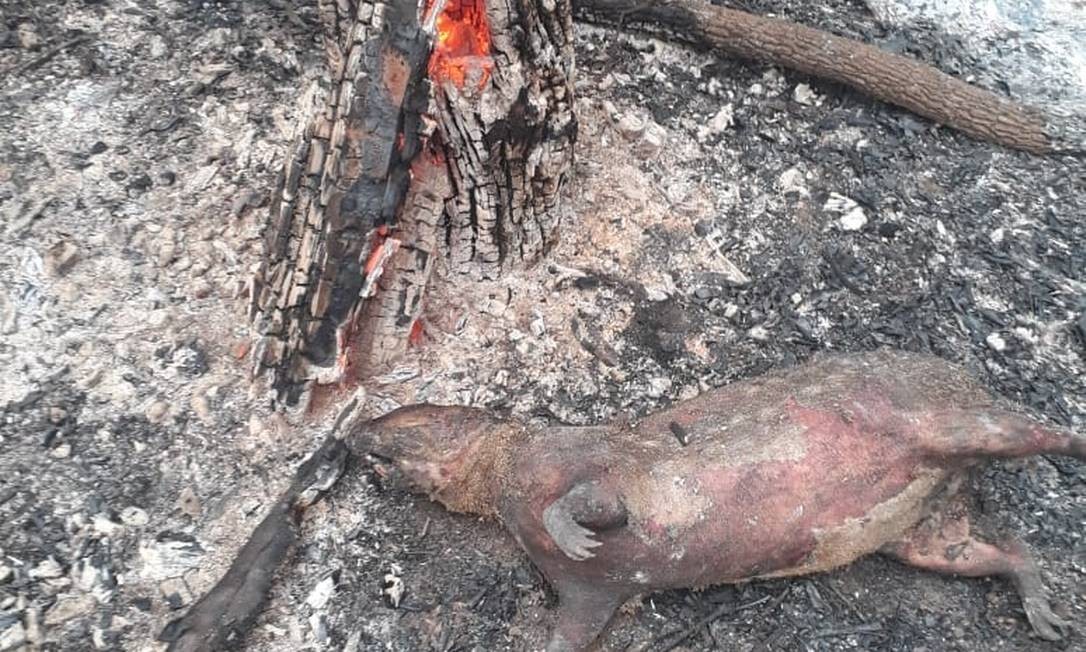
850 kilometers away, in the city of Lucas do Rio Verde, still in the territory of the state of Mato Grosso, a team of the Corps de Firefighters found along the way a paca also killed by the fire of a burn.
Next to a log that has already been turned to embers, the paca was photographed by one of the military last Tuesday, August 20. It was not a case isolated. There, firefighters encounter dead animals daily as they try to contain the fires in the area of Lucas do Rio Verde.
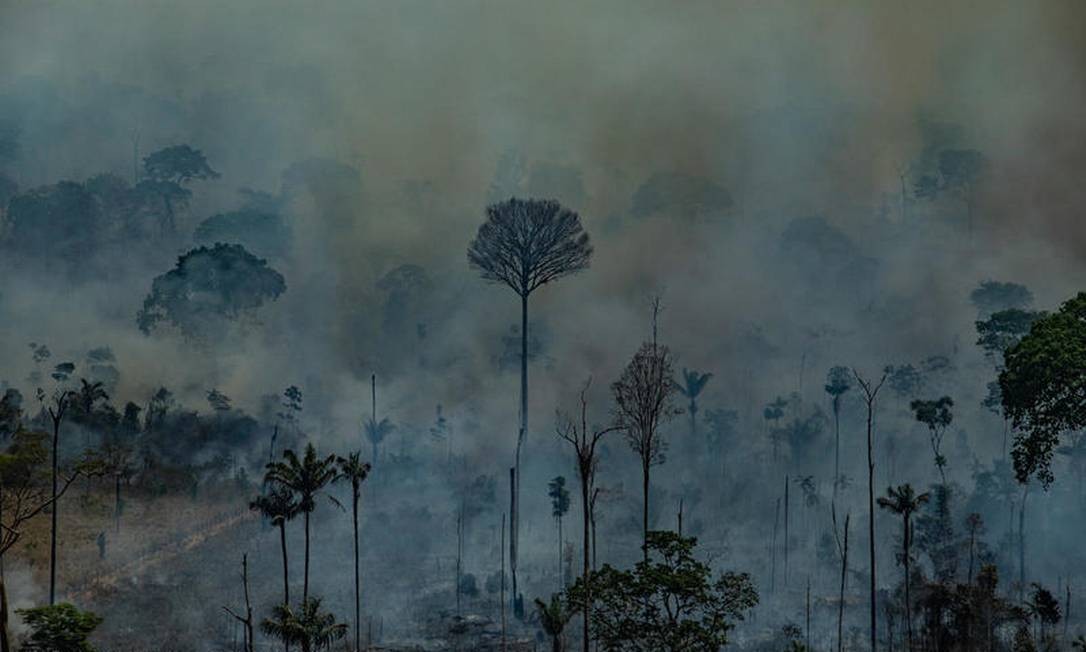
According to a report produced by the environmental organization WWF Brasil and released exclusively to ÉPOCA, there are currently 265 endangered species in the fire-stricken parts of the Amazon: 180 fauna and 85 flora.
Of the total mentioned, 76% of the species are protected in conservation areas or supported by public protection policies National Action Plans for the Conservation of Endangered Species or Speleological Heritage (PAN).
Fire hits conservation units
The demarcated safety zone for some animals, however, disappears at the threat of burning. WWF survey points some reserves already reached, such as: Xingu Triunfo Environmental Protection Area in Pará (PA), Jaci Paraná Extractive Reserve (RO), Ecological Terra do Meio (PA), Chico Mendes Extractive Reserve (AC) and Amanã National Forest (AM / PA).
According to the project manager of WWF Brazil, Gabriela Viana, the numbers result from a crossing of the areas most affected by the burnings, the from recent data from the National Institute for Space Research (Inpe), with information on the fauna of the region from the WWF database and also from the Chico Mendes Institute for Biodiversity Conservation (ICMBio).
“Part of the financial resources taken from the Amazon was precisely related to fire fighting and prevention. You must redeem this investment, not only to prevent the current fire from spreading further, but mainly to recover lost areas,” analyzed Gabriela.
Among the species within the protected areas, eight are considered more vulnerable to burning as Ararajuba, Gavião real, Tapir and Amazon Manatee.
Outside the protected areas, some species are worse off, without any form of defense, such as the vested cuicca which is already considered critically endangered.
Used to walking in the reserve of his region, with almost 165 thousand hectares in the stretch between the municipalities of Aripuanã and Colniza, José Cândido Primo He said he currently finds a scenario he has never seen before.
“Last week I walked through a cleared area of approximately 200 hectares of land to see what was going on. On the edge of a stream found three dead pacas, burned snake skulls, and a still-burning sloth that died after debating over there. All of this in a deforestation considered small for the proportions of what is happening this year, ”said Primo, who currently works with the extraction of Brazil nuts and copaíba oil, two typical species of the region.
He reports that the fire in the forest region is not accidental, but directed at deforestation: “In our region, the economy is driven by wood and livestock soon follow. So we were very harmed, unable to pass this on to the responsible entities because here the loudest speaker is the logger, it is the extraction of wood. After they cut down and burn the woods next to the chestnut trees, 99% of the planting dies and those that remain will not produce more”, he lamented.
Incêndios na Amazônia espalham animais carbonizados em áreas destruidas
 © GABRIELA BILO / ESTADAO
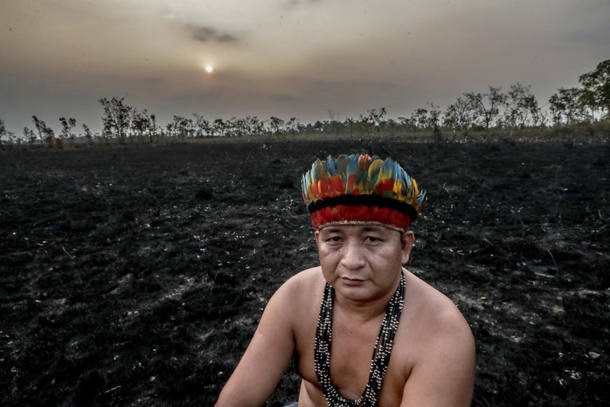
The Tharin indigenous live an area of the Amazon where illegal deforestation and land grabbing surface to the naked eye, a green belt where the
fire “springs from nowhere” in the middle of the virgin forest. With the strong winds, the flames move uncontrollably – without us being able
detect the perpetrators of the fire. “We take care of this land, our territory. To this day, the fire had not entered. But now it came at once, in several places. It’s a dread for our people, because it makes our children sick, kills the animals, only brings bad things,” says Tenharin, sitting on a mound of earth in the middle of the black ground.
Índios do sul do Amazonas achavam que estavam livres dos incêndios acabaram dentro da catástrofe
 pet is love!!